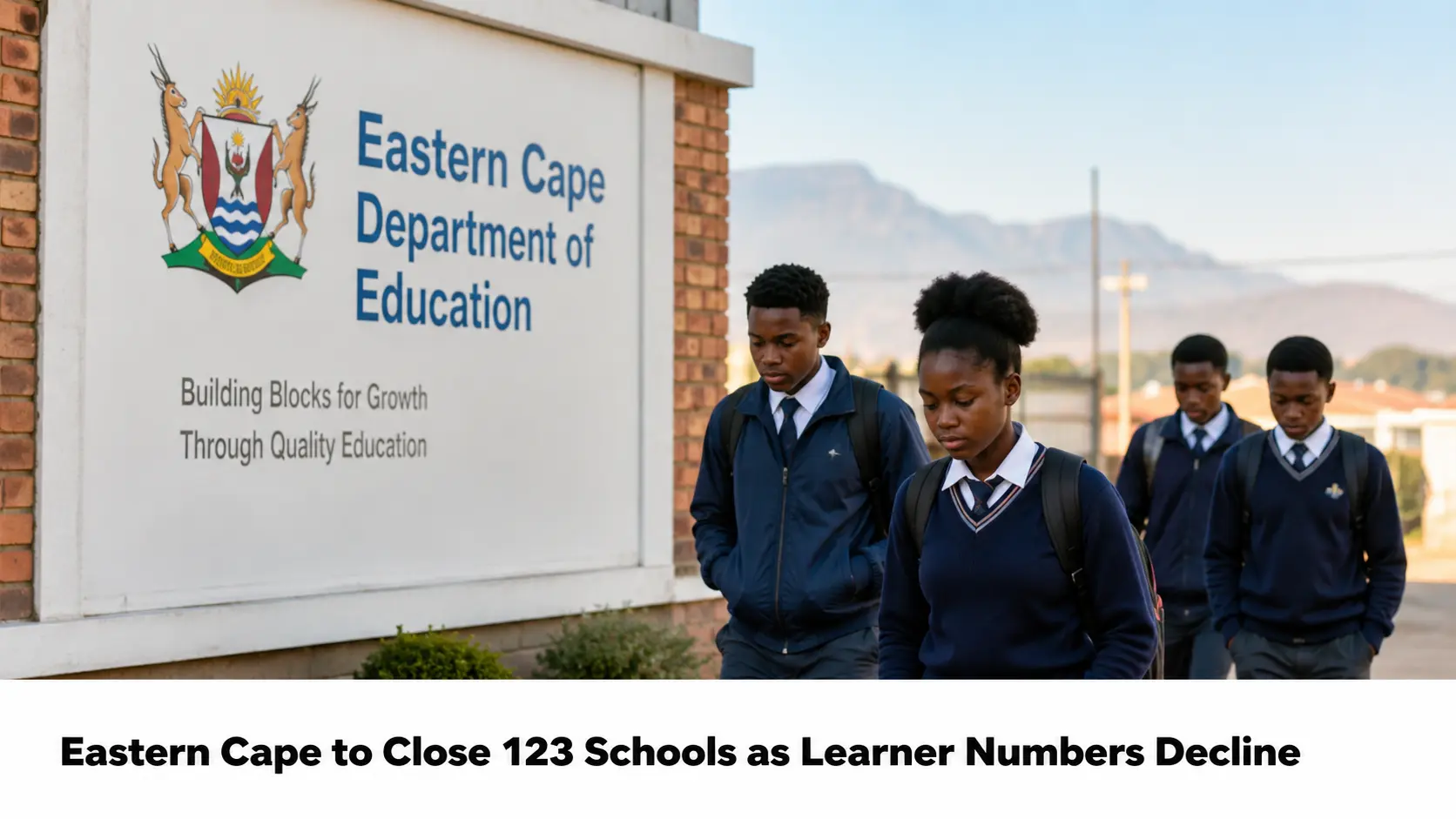
The Eastern Cape Department of Education has confirmed that 123 schools are set to close during the coming financial year, as the province responds to declining learner enrolment and the impact this has on the allocation of teachers and other education resources.
The department has also identified another 300 schools for possible closure in the coming years as part of a broader school rationalisation programme.
The plan involves merging schools with very low learner numbers and moving affected learners to other schools that can accommodate them.
While the department says the changes are necessary to ensure that available resources are used more effectively, the closures are expected to have a significant impact on rural communities, where schools can be an important part of local life.
Eastern Cape School Closures at a Glance
| Information | Details |
|---|---|
| Province | Eastern Cape |
| Department | Eastern Cape Department of Education |
| Schools scheduled for closure | 123 |
| Additional schools identified | 300 |
| Main reason | Declining learner numbers |
| Programme | School rationalisation |
| Affected areas | Particularly rural communities |
| Planned solution | School mergers |
| Learner arrangements | Transfer to receiving schools |
| Transport | Government is working on transport arrangements |
| Implementation | Coming financial year and subsequent years |
Why Is the Eastern Cape Closing Schools?
The department says the primary reason for the closures is declining learner enrolment.
According to Eastern Cape Department of Education spokesperson Malibongwe Mtima, schools are resourced according to the number of learners they serve.
When learner numbers fall, schools can receive fewer educators and fewer resources.
This can make it difficult to maintain very small schools at their existing size.
The department is therefore reviewing schools with low and declining enrolment and considering whether they should be merged with other nearby institutions.
The objective is to concentrate available resources in schools where they can support larger numbers of learners.
What Is School Rationalisation?
School rationalisation involves reviewing the number, size and location of schools and making changes where learner numbers or other circumstances have changed.
In the Eastern Cape, the process involves the merging of under-enrolled schools.
Instead of maintaining separate schools with very small enrolments, learners can be moved to another school.
The department says this approach can help improve the distribution of:
- Teachers
- Classrooms
- Education resources
- Infrastructure
- Administrative support
However, rationalisation can be more complicated in rural areas because communities may be spread across large distances.
Rural Communities Face the Biggest Impact
The department has acknowledged that rural areas will be particularly affected by the school closures.
For some rural families, the nearest alternative school may be significantly further away than the school their children currently attend.
This makes transportation one of the most important issues in the implementation of the programme.
The department says it is working with other government officials, including the Department of Transport, to address the transport needs of learners affected by school mergers.
The aim is to ensure that learners can safely reach the schools where they will continue their education.
What Happens to Learners When Schools Close?
The closure programme is based on merging schools and relocating learners, rather than removing access to education.
Learners from schools that are closed are expected to be accommodated at receiving schools.
Before a merger takes place, several issues need to be considered, including:
- The capacity of the receiving school
- Available classrooms
- Teacher numbers
- Distance between schools
- Transport arrangements
- Grade availability
- Infrastructure
- Learner safety
The exact arrangements will vary from one community to another.
Parents should therefore obtain information directly from their school or the provincial education department if their school has been identified for rationalisation.
300 More Schools Identified for Future Closures
The 123 schools currently scheduled for closure form part of a much larger rationalisation programme.
The department has identified another 300 schools for closure in the coming years.
However, these 300 schools should not be described as schools that have already been closed.
They form part of the department’s longer-term plans and assessments.
The implementation of future closures will depend on the department’s rationalisation process and the circumstances of individual schools.
This distinction is important for parents and communities because the status of a particular school may change as consultations and planning continue.
Why Learner Numbers Are Declining
The department’s immediate explanation for the school closures is declining enrolment.
Lower learner numbers can affect the viability of schools because staffing and resource allocations are linked to learner populations.
Where a school has very few learners, maintaining the same level of infrastructure, teaching staff and administrative resources may become difficult.
The department therefore wants to consolidate resources in schools with sufficient enrolment to support sustainable education delivery.
The announcement does not, however, mean that every school experiencing a reduction in enrolment will necessarily close.
The rationalisation programme focuses on schools identified by the department as requiring intervention.
What Will Happen to Teachers?
Teacher allocations are also affected when learner numbers decline.
According to the department, lower enrolment can result in fewer educators being allocated to schools.
School mergers are intended to help address this issue by bringing learners and resources together.
Teachers affected by closures or mergers will be dealt with through the department’s relevant staffing and placement processes.
The information currently available does not provide a complete list of teacher placements or the number of educators affected.
Transport Will Be Important
Transport is one of the biggest practical challenges associated with the closures.
In rural areas, learners may have to travel considerably further after their local school is merged with another institution.
The Eastern Cape Department of Education says it is coordinating with other government departments to ensure that transportation is provided where required.
For affected families, transport arrangements will therefore be an important part of the transition.
Parents should confirm:
- Which school their child will attend.
- How far the receiving school is from home.
- Whether learner transport is available.
- Where transport will collect learners.
- When the new arrangements will begin.
Why the Department Says Closures Are Necessary
The department maintains that the rationalisation programme is necessary to support sustainable education delivery.
The Eastern Cape has faced ongoing challenges involving education resources and infrastructure.
Maintaining numerous small schools with declining enrolment can make it difficult to distribute teachers and other resources efficiently.
The department believes that merging some schools will allow available resources to be used more effectively.
The programme therefore involves a balance between two important considerations:
Resource efficiency: ensuring teachers and education resources are allocated where they are most needed.
Access: ensuring learners, particularly those in rural communities, can continue attending school without unreasonable travel or safety challenges.
What Parents Should Know
Parents should not assume that every school mentioned in social-media posts is definitely closing.
If a child’s school is affected, the department or school should provide information about the next steps.
Parents should ask for confirmation of:
- The school’s closure or merger status.
- The receiving school.
- The effective date.
- Learner transport arrangements.
- Registration or transfer requirements.
- Grade and subject availability at the receiving school.
Parents should also keep official communication received from the school or department.
Is This a New School Closure List?
The announcement concerns a rationalisation programme involving under-enrolled schools.
The 123 schools are the group identified for closure during the coming financial year, while another 300 have been identified for future rationalisation.
A complete school-by-school list should only be treated as authoritative if it is published or confirmed by the Eastern Cape Department of Education.
Frequently Asked Questions
How many schools will close in the Eastern Cape?
The department has confirmed that 123 schools are scheduled for closure during the coming financial year.
Why are the schools closing?
The main reason given by the department is declining learner enrolment.
Are another 300 schools also closing?
Another 300 schools have been earmarked for closure in the coming years as part of the broader rationalisation programme.
Will learners have to stop attending school?
No. The plan involves merging schools and transferring affected learners to other schools.
Will transport be provided?
The department says it is working with other government entities to provide transport arrangements for learners affected by school mergers.
Will rural areas be affected?
Yes. The department has acknowledged that rural communities are expected to be particularly affected.
What happens to teachers at closing schools?
Teacher allocations will be affected by changing learner numbers, while educators impacted by mergers will be managed through the department’s staffing processes.
Are all schools with low enrolment being closed?
Not necessarily. The announcement relates to schools identified through the department’s rationalisation process.
When will the 123 schools close?
The closures are planned for the coming financial year, with the process already being implemented at some facilities.
Are the 300 future closures confirmed?
They have been earmarked for closure in the coming years, but they should not be presented as already closed.
Key Takeaways
- 123 Eastern Cape schools are scheduled to close during the coming financial year.
- The department says declining learner numbers are the main reason.
- 300 additional schools have been identified for future rationalisation.
- The programme involves merging under-enrolled schools.
- Affected learners will be moved to receiving schools.
- Rural communities are expected to experience much of the impact.
- Government departments are working on transport arrangements for affected learners.
- The department says the programme is intended to improve the use of teachers and other education resources.
- Parents should verify their individual school’s status through official channels.
- The 300 additional schools should not be described as already closed.
Editorial Policy
This article is based on information concerning the Eastern Cape Department of Education’s school rationalisation programme and reporting on the department’s statements.
We clearly distinguish between the 123 schools scheduled for closure in the coming financial year and the 300 schools earmarked for future rationalisation.
We do not present projected or planned school closures as completed closures. We also do not publish unverified school lists, transport arrangements or learner placement information as confirmed facts.
Parents and learners should verify information concerning a specific school directly with the Eastern Cape Department of Education or the school concerned.
Official Sources and References
- Eastern Cape Department of Education — official provincial education authority.
- Department of Basic Education — national education policy and information.
- Reporting on the Eastern Cape school rationalisation programme and statements by department spokesperson Malibongwe Mtima.
Tip for Parents
If your child’s school may be affected, wait for official confirmation before making arrangements. Ask the school or Eastern Cape Department of Education about the receiving school, transfer arrangements and learner transport before the closure takes effect.