
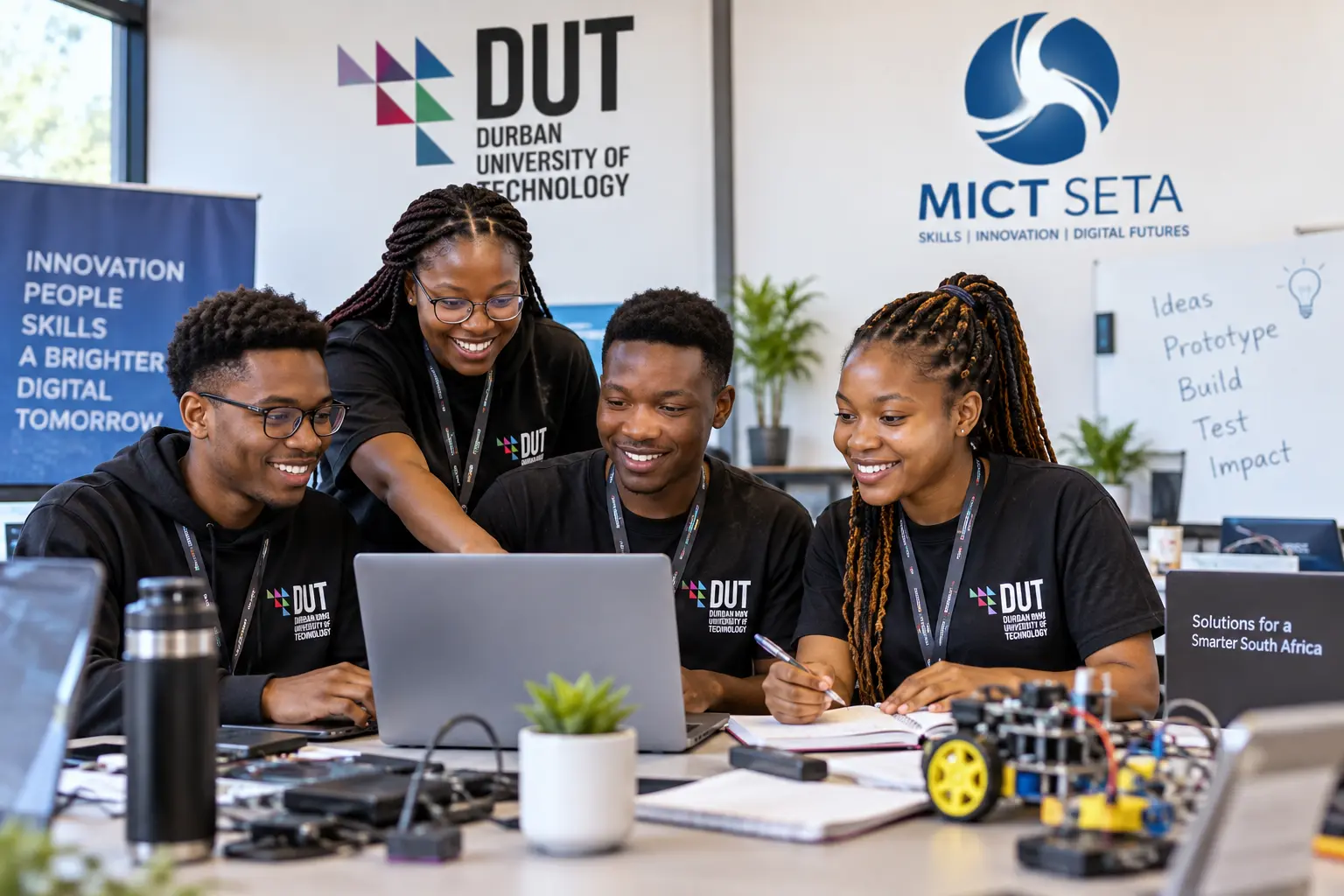
Students at the Durban University of Technology (DUT) have secured first, second and third placements at the KwaZulu-Natal regional round of the MICT SETA National Skills Challenge Hackathon.
The two-day regional competition was held at the MKRI offices in Durban on 22 and 23 March 2026. The event was dominated by DUT’s Faculty of Accounting and Informatics, with all three winning teams coming from that department.
DUT clean sweep of regional podium demonstrates skills in digital technology
The first-place prize went to DUT Informatics, with Lindokuhle Mnguni, Queen Hadebe and Sanelisekile Nqabeni.
The team received R100,000 for winning the regional competition.
Team Demo came in second, with Clever Programming finishing third. Both received R50,000 each.
The results were:
| Position | Team | Prize | |
| — | — | ——–: |
| First | DUT Informatics | R100,000 |
| Second | Team Demo | R50,000 |
| Third | Clever Programming | R50,000 |
All three teams were from the DUT’s Faculty of Accounting and Informatics.
DUT Informatics project in tourism sector wins first prize
The winning team’s DUT Informatics project was in the area of tourism, a reflection of the general aim of hackathons, which is to encourage more students to apply their knowledge practically.
For the students who took part, the opportunity to apply their programming, problem-solving, team-working and innovation skills is an invaluable experience.
Team Demo project in tourism sector wins second prize
The team in second place also chose tourism as the focus of its project.
It has created an application to help users identify potentially dangerous areas, and suggest alternative routes, with the aim of enhancing their experience of exploring a destination.
Team member Siqiniseko Ntombela described the result as a proud moment for the team, and one that motivates them to continue their studies and develop their skills.
The project is an example of how student technology competitions can extend beyond their technical aspects, and address practical problems encountered by people in their everyday lives.
Clever Programming takes third prize in regional hackathon
Clever Programming came in third, with Gomotso Mohapi, Ntokozo Ngcobo and Lwazi Ncongwana.
Its third-place result completed the DUT sweep, with all three podium positions occupied by teams from the university.
For the Faculty of Accounting and Informatics, the result means a strong showing across multiple teams, rather than a single outstanding entry.
Engineering Practice Innovation Project model
The DUT has attributed the result partly to its Engineering Practice Innovation Project (EPIP) model, which is executed via the faculty’s specialist laboratories.
According to the university, the model seeks to promote practical innovation and encourage students to develop solutions.
The success of three separate DUT teams at the same competition is an indicator of the value of providing opportunities for students to apply their technical knowledge to practical problems.
DUT Informatics team to compete in national hackathon
The result at the regional level also provides the winning team with an additional opportunity.
DUT Informatics will advance to the national competition in Johannesburg, where it will represent KwaZulu-Natal at the next stage. The competition at the national level will be of a different standard, with teams from other regions also competing. For Mnguni, Hadebe and Nqabeni, the next challenge will be to build on their regional result when competing nationally.
Digital and future skills key at MICT SETA technology hackathon
The hackathon is an important part of skills development, proving that technical education is not just about obtaining a qualification, but also an opportunity to gain experience in solving problems, working collaboratively with others and finding solutions that have practical application. This is particularly relevant at a time when employers in the information technology, software development and digital innovation fields are looking for graduates who can demonstrate the application of their knowledge.
MICT SETA has identified digital and future-oriented skills as an important part of its skills-development mandate, which also covers the areas of artificial intelligence, cybersecurity, cloud computing, data science, software development and the Internet of Things.
Why it matters: DUT students sweep regional technology competition
Securing all three podium positions in a regional national skills competition is a tremendous achievement for the participating DUT students.
The R100,000 prize for first place means recognition for the team’s work, with the other two positions reflecting the breadth of the university’s success.
The next test will be at the national competition in Johannesburg.
For the students who took part, the experience provides more than just competition results. It gives them an opportunity to demonstrate their technical abilities, build confidence in developing practical solutions and gain exposure beyond the university environment.
As the DUT Informatics team prepares for the national stage, its regional victory has already placed the university’s student innovators firmly in the spotlight.
Source and reporting note
This article is independently written using information published by the Durban University of Technology regarding its students’ performance at the MICT SETA National Skills Challenge Hackathon KZN Regionals. Additional context on the focus of MICT SETA on digital and future skills is provided from information published by MICT SETA.
Editorial policy
We make a distinction between confirmed competition results and observations about the value of student innovation. Information on prize amounts, team members and progression to the national competition is reported on the basis of the university’s published account.
Disclaimer
Winning a regional hackathon does not represent a guarantee of employment, investment or commercial success for the participating teams or their projects. The national competition is a separate category of competition.
