
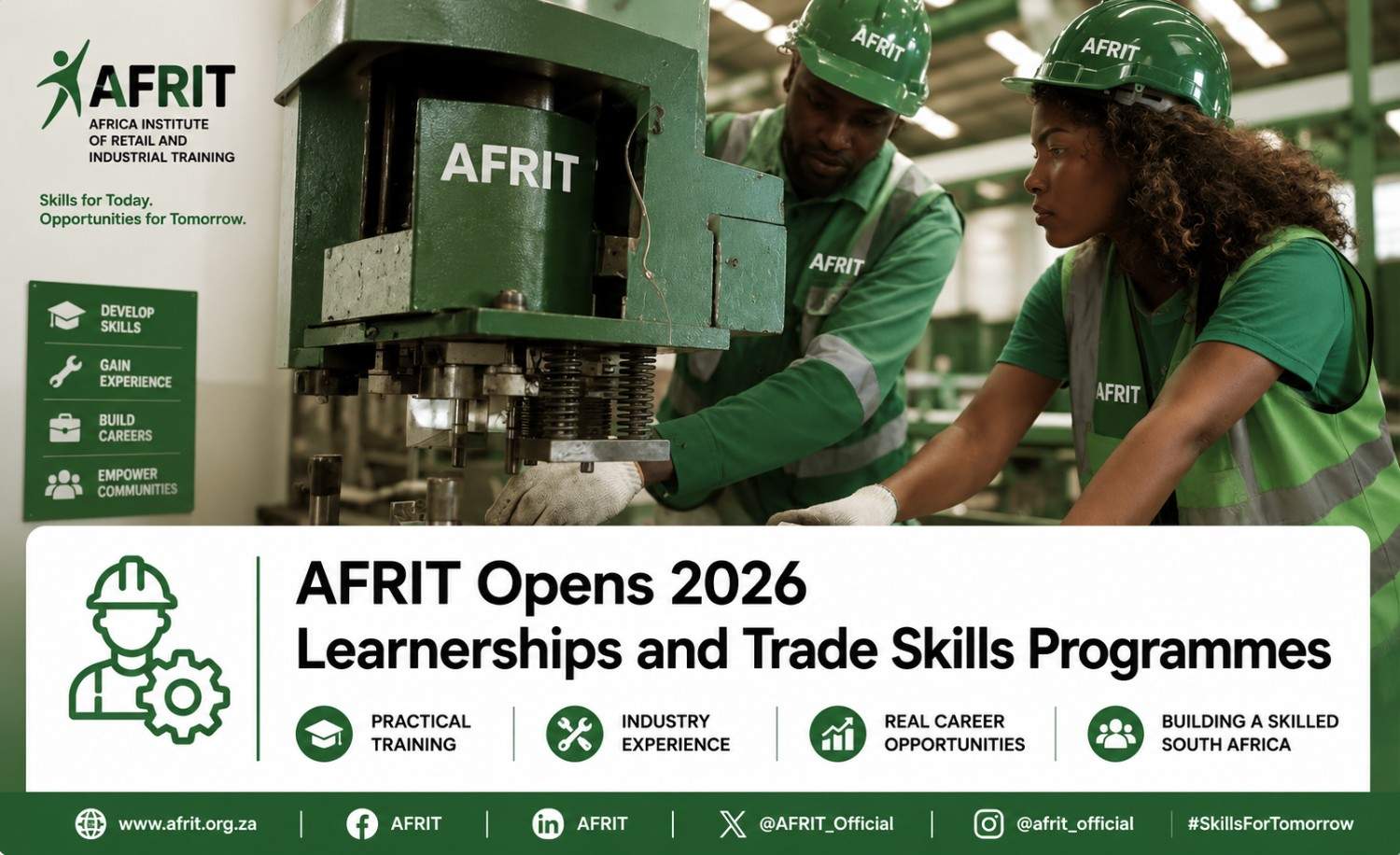
AFRIT has announced its 2026 learnerships and skills-development programs with opportunities in business, warehousing, welding, quality-assurance, production and vehicle-body building.
AFRIT 2026 learnerships target South African youth between the ages of 19 and 28, with both employed and unemployed candidates eligible to apply, according to the information provided.
Some of the programs emphasize practical and occupational skills, while one of them is explicitly aimed at Persons with Disabilities (PWDs). The stipend advertised for this round of training ranges from R3500 to R5500, depending on the selected program and its funding.
AFRIT 2026 learnerships had a closing date of 4 th June 2026 at 17:00, and classes are due to commence in the latter half of the year. See the overview below:
AFRIT Skills Development Programmes 2026 Overview
| Programme Title | Level | Focus Area(s) |
|---|---|---|
| National Certificate: Business Administration Services | NQF Level 2 | Business administration |
| National Certificate: Management Stores and Warehousing | NQF Level 3 | Warehousing |
| National Certificate: Welding Application and Practice | NQF Level 2 | Welding |
| Occupational Certificate: Quality Assurer | NQF Level 4 | Quality assurance |
| Occupational Certificate: Production Operator | NQF Level 3 | Production |
| Intermediate Occupational Certificate: Vehicle Body Builder – Metal | NQF Level 4 | Vehicle body building |
AFRIT Skills Development Programs 2026: A Programme With Different Routes Into the Workplace
AFRIT’s recruitment drive is notable for its range of opportunities, as the organization does not target a specific profession or field.
Some of the courses listed above fall under office administration or manufacturing, while others support warehousing, logistics, quality-assurance or more niche technical trades. This variety creates multiple access points into the working world for South African youth, depending on their academic background or personal preference.
While the technical programs may be an ideal fit for those who want to gain practical skills, the more office-oriented opportunities also serve as a career entry point for aspiring administrators and managers.
Those interested in one of these opportunities should note that not all programs have identical entry requirements, so it is best to research a specific course before applying.
AFRIT Skills Development 2026: Business Administration Services NQF Level 2
AFRIT’s National Certificate: Business Administration Services program is exclusively for PWDs, providing an entry-level qualification for aspiring office workers.
As the name suggests, the course covers fundamental business administration functions, potentially including office operations, business communication, record management, customer-support services, and related fields. It also serves as a stepping stone into the business world for those without prior work experience.
AFRIT Skills Development 2026: Management Stores and Warehousing NQF Level 3
It is important to understand that warehousing is not a standalone profession but rather a component of the larger supply chain management process.
AFRIT’s National Certificate: Management Stores and Warehousing course offers the practical skills needed to work in inventory management, stock control, logistics and distribution, and similar fields. The candidate will also learn the basics of warehousing operations and the role that storage facilities play in the overall supply chain.
AFRIT Skills Development 2026: Welding Application and Practice NQF Level 2
AFRIT’s National Certificate: Welding Application and Practice course provides a foundational understanding of welding and the metalworking industry.
The program offers technical knowledge in welding practices and procedures, with a strong focus on workshop safety and practical application. Students will also learn the fundamentals of metallurgy, fabrication, and other related fields.
AFRIT Skills Development 2026: Quality Assurer NQF Level 4
AFRIT’s Occupational Certificate: Quality Assurer is another technical program that supports the manufacturing and logistics industry.
It covers quality-assurance procedures and related workplace practices, with a strong emphasis on compliance management. It also includes theoretical knowledge in organizational quality-assurance practices and procedures.
AFRIT Skills Development 2026: Production Operator NQF Level 3
AFRIT’s Occupational Certificate: Production Operator is ideal for those seeking a career in the production field.
The course provides an overview of the production process, with students gaining practical insight into manufacturing operations and associated workplace procedures. It also includes training on production equipment operation and safety practices.
AFRIT Skills Development 2026: Vehicle Body Builder – Metal NQF Level 4
AFRIT’s Intermediate Occupational Certificate: Vehicle Body Builder – Metal is the most specialized program in terms of technical expertise.
The course focuses on vehicle-building procedures and metalworking practices, with students learning relevant building techniques and workshop practices. It is suited to those interested in automotive manufacturing and related fields.
AFRIT 2026 Skills Development: Who Can Apply?
AFRIT’s 2026 skills-development programs are open to South African youth between the ages of 19 and 28. According to the information provided, both employed and unemployed candidates can apply.
Additional requirements include:
- Being South African Youth
- Meeting the eligibility criteria for the selected course
- Coming from prioritized local communities
- Meeting additional requirements if applicable
AFRIT also notes that certain groups of people take priority over others, including Africans, Coloureds, Indians, women, and Persons with Disabilities. Eligibility criteria vary between programs, so it is best to review the requirements for a specific course before applying.
AFRIT 2026 Skills Development: Documents Required for Application
AFRIT’s 2026 application process requires the following documents:
- Updated short CV
- Certified copy of South African ID
- Certified copy of highest academic qualification
- Doctor’s note (certified copy) if applying as a person with disabilities
Applicants should ensure that all documents are updated and legible. Additionally, it is important to select a program that suits one’s academic credentials and personal interests.
AFRIT 2026 Skills Development: Stipend Information
AFRIT advertises a stipend of between R3500 and R5500 for its 2026 programs, depending on the selected course and its funding.
AFRIT 2026 Skills Development: Application Process
According to the information provided, AFRIT requires application by email:
Email Address: SDF@afrit.co.za
Attention: Prudence Ramufhi (SDF)
Applicants should clearly state their preferred course and attach the required supporting documents. Since the deadline has passed, it is best to confirm with AFRIT whether applications are still open before sending documents.
AFRIT 2026 Skills Development: Closing Date
The deadline for AFRIT’s 2026 programs was 4 th June 2026 at 17:00. The course commences at the end of June 2026.
AFRIT 2026 Skills Development: Why These Skills Matter
AFRIT offers a wide range of skills-development programs, which makes it possible to gain practical training in multiple fields.
Some of the courses provide foundational skills in administration, logistics, and manufacturing, while others support more specialized areas such as welding and vehicle-body building. Additionally, business administration skills open the door to managerial positions.
For the right candidates, the combination of theoretical knowledge and practical application has long-lasting career benefits. However, it is important to note that a learnership does not guarantee a job offer after training.
AFRIT 2026 Skills Development: FAQ
What are the available programs at AFRIT 2026?
AFRIT 2026 offers learnerships in business administration, warehousing, welding, quality-assurance, production, and vehicle-body building.
Who can apply for the AFRIT 2026 programs?
AFRIT’s 2026 programs welcome South African youth between the ages of 19 and 28, with both employed and unemployed candidates eligible to apply.
Are there any stipends for the AFRIT 2026 programs?
AFRIT advertises a stipend of between R3500 and R5500 for its 2026 programs, depending on the selected course.
Are there any courses aimed at Persons with Disabilities?
Yes, AFRIT’s National Certificate: Business Administration Services is explicitly aimed at Persons with Disabilities.
What documents are required for AFRIT 2026 applications?
AFRIT 2026 applications require an updated short CV, a certified copy of South African identity documents, and a certified copy of the highest academic qualification. For persons with disabilities, a doctor’s note is also required.
How can I apply for AFRIT 2026?
AFRIT requires applications by email to SDF@afrit.co.za , with attention to Prudence Ramufhi (SDF).
What is the closing date for AFRIT 2026 applications?
AFRIT 2026 applications close on 4 th June 2026 at 17:00.
AFRIT 2026 Skills Development: Note
AFRIT’s program advertisements indicate that their 2026 applications close on 4 th June 2026. This means that the date has passed, and this article does not encourage further applications. Prospective candidates are advised to contact AFRIT directly to confirm whether applications are still open.
AFRIT 2026 Skills Development: Transparency Note
This article was written based on the information published on AFRIT’s Learnerships and Skills Development Programmes 2026 recruitment drive. Additionally, program-specific requirements and stipend information have been separated from general commentary.
The publisher is not affiliated with AFRIT and does not facilitate recruitment or applications in any capacity. Readers are encouraged to verify the information independently and contact AFRIT directly before submitting applications or personal documents.
AFRIT 2026 Skills Development: References
AFRIT Learnerships and Skills Development Programmes 2026 recruitment drive.
South African National Qualifications Framework information.
Department of Higher Education and Training skills-development resources.
South African skills-development and occupational-training framework information.
